

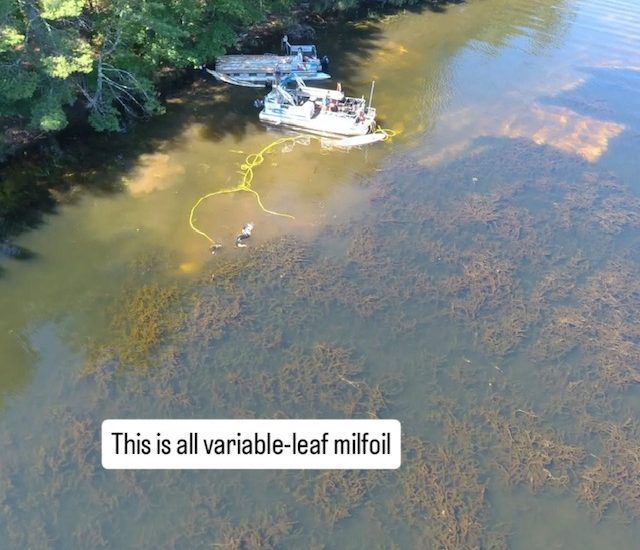
Invasive variable-leaf milfoil remains a serious threat at Sebago Lake State Park, where dense growth around the boat launch and in nearby coves of the Songo River creates ideal conditions for spread. The infestation is especially concerning because milfoil fragments can break off easily, hitchhike on propellers and trailers, and start new colonies elsewhere in Sebago Lake or connected waterways. State officials have underscored the seriousness of the problem by maintaining a temporary surface-use restriction in the affected area near the state park ramp to support control work, reduce spread, and protect dive crews during removal efforts. The restriction runs through December 31, 2026, but will likely be extended for another year, and no watercraft, except for milfoil control, may enter the area.
Lakes Environmental Association, or LEA, has been on the front lines of this work for years. LEA has managed variable-leaf milfoil in the Songo River system since 2003. After more than a dozen hard years, LEA’s work has brought the river and Brandy Pond infestations under control, but because of the extent of the original infestation and the amount of boat traffic, continued maintenance is still necessary. That progress matters because the Songo is one of the region’s busiest boating corridors, and reducing infestation there helps limit downstream and upstream spread. But progress comes at a cost.
The lesson is clear: milfoil control is not a one-season fix.
Today, LEA’s focus includes the worst patches in Sebago Lake and Sebago Cove, along with high-traffic areas such as the State Park launch. Its strategy combines persistent monitoring with diver-assisted hand removal, suction harvesting, and benthic barriers that block sunlight and kill plants beneath them. In 2025, LEA hired 17 seasonal staff, removed more than 1,470 bags of milfoil, and installed 237 benthic barriers. More than 636 of those bags came from the Songo River. The State Park launch shows why persistence matters: LEA’s crews spent more time there than anywhere else that season, suction-harvesting it repeatedly and laying over 40 barriers, yet regrowth continued.
The lesson is clear: milfoil control is not a one-season fix. It takes funding, coordination, and vigilance from agencies, nonprofits, and boaters alike. Thanks to LEA’s sustained efforts, Sebago Lake State Park is seeing a determined response aimed not just at suppression, but at protecting the entire lake system and keeping milfoil out of neighboring, uninfested lakes like Moose Pond.
We all must stay vigilant! When you are on the pond or along the shore, keep an eye out for suspicious plants and send photos to LEA for identification (mainelakes.org/invasives/plant-submission). Boaters, please clean, drain, and dry your boats, and let the Courtesy Boat Inspectors double-check. They are experts. We all need to work together to protect our lakes.
