

Help with the Fight Against Aquatic Invasive Species:
A
lay person can absolutely help with early detection in Moose Pond, especially on a lakefront property. The safest and most useful ways to help are to:
- learn the few highest-risk aquatic invaders to watch for
- notice anything unusual early
- document it well
- report it for expert review rather than trying to treat it yourself. It is often illegal to remove aquatic plants without permission
What to focus on first:
- For a lakefront homeowner in southern Maine, the biggest concern is usually invasive aquatic plants
- Invasive aquatic plants spread easily between waterbodies and even small fragments can start infestations

A practical short list of invasive plants to be alert for includes:
In southern Maine specifically, it makes sense to be especially alert for variable-leaf watermilfoil, because Maine DEP highlights it as one of the most concerning aquatic invaders in the state.
You do not need to become a botanist. You just want to notice plants that seem new to your shoreline or unusual such as:
- Dense underwater growth where you don’t remember seeing it before
- Surface mats that interfere with swimming, paddling, or fishing
- Fast spread along shoreline shallows
- Unique plants appearing in only one cove, around a dock, or near a boat landing where fragments may have arrived first
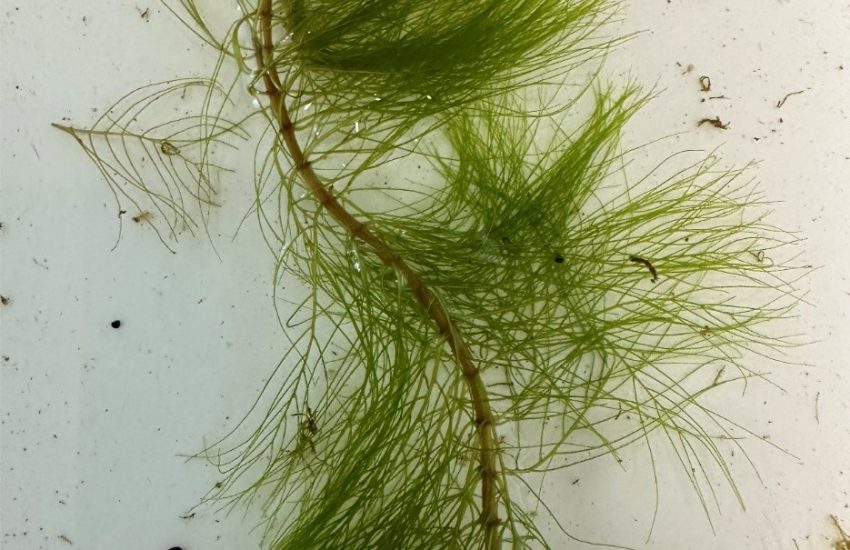
Variable-leaf watermilfoil:
- This common invasive is submerged, has feathery leaves in whorls, is most often found in shallow shoreline water, and it can form thick mats near the surface. It spreads readily by fragmentation.
Here’s a simple and useful homeowner routine:
- Check your shoreline every 2–4 weeks in the growing season, especially late spring through early fall.
- Look around docks, swim areas. boat lifts and coves with low water movement
- If you kayak, canoe, or use a small boat, do a slow pass over the nearshore shallows and look down into the water on sunny days.
- Pay attention to new patches rather than trying to identify every plant in the lake.
- Early detection is often about spotting something unfamiliar.
Maine DEP gives a very specific process for suspicious aquatic plants:
- Snip off the top of a healthy stem, about 12 inches long
- Float it in a tray, ideally with a white bottom
- Spread it out so the leaf arrangement on the stem is visible
- Take a clear close-up photo with minimal glare
- Submit your photos via LEA’s suspicious plant portal at
https://mainelakes.org/invasives/plant-submission/
You will be asked to include your name, phone number, date collected waterbody name and town name.
What not to do (this part matters a lot):
- Don’t apply herbicides yourself.
- Don’t start ripping out large amounts of vegetation unless you know exactly what it is and what’s allowed.
- Don’t move plant fragments to shore, another cove, or another waterbody.
Maine DEP points to Lake Stewards of Maine for training in aquatic plant identification and monitoring. That is the best next step if you want to become more familiar with both native and invasive aquatic plants.
