
Message from the president
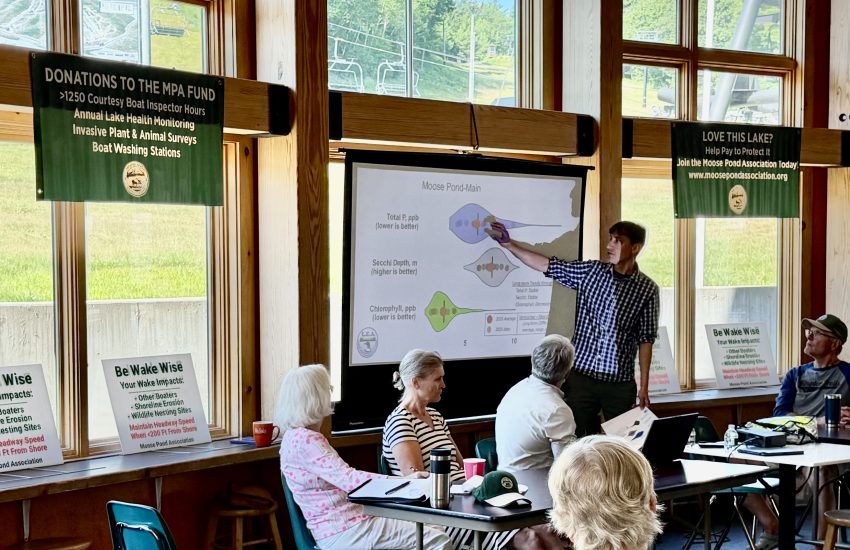
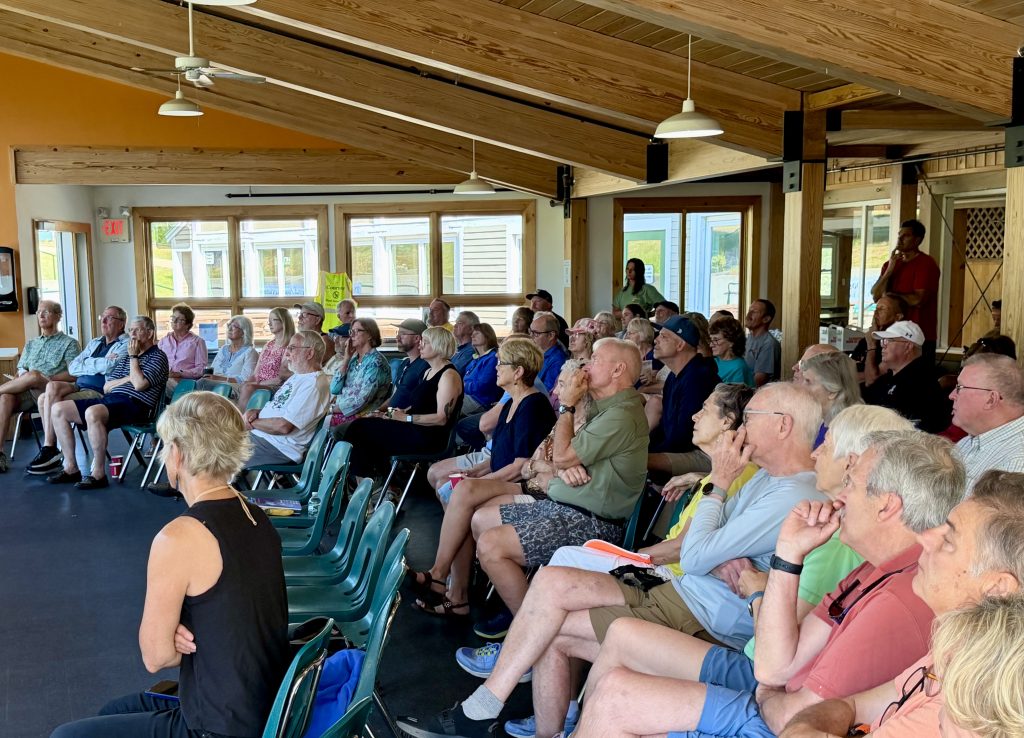
On Saturday, July 11, I hosted our Annual Meeting at Pleasant Mountain’s main lodge. Roughly 100 interested attendees gathered to hear a wide-ranging update on the health of Moose Pond and the work being done to protect it.
The centerpiece of the meeting was a detailed lake health update from Colin Holme, Executive Director of the Lakes Environmental Association (LEA). Before introducing Colin, I reminded attendees that Moose Pond is surrounded by lakes already dealing with invasive species, particularly variable leaf milfoil. I mentioned this to highlight that protecting Moose Pond requires vigilance, ongoing monitoring, and community support.
Colin praised the MPA as one of the most active and engaged lake associations in the region and highlighted Moose Pond as a model for adopting leading science quickly. Because of the association’s strong financial footing, Moose Pond has become the first lake in the greater Bridgton area where LEA is conducting environmental DNA testing as an early warning system for invasive plant infestations.
The encouraging news from LEA was that no invasive plants or animals were found in Moose Pond during their 2025 inspections of hotspot areas such as boat launches, marinas, and the narrows between basins. Colin urged residents to stay alert and report suspicious plants by photographing them in pond water against a white background and sharing the image with LEA, along with the time, date, and location of collection.
Colin also reviewed lake testing trends for the North, Main, and South basins. In 2025, average phosphorus, water clarity, and chlorophyll readings were at or better than long-term averages. Long-term conditions remain stable overall, although there has been a slight increase in phosphorus in the South Basin – something LEA will continue to watch closely – while chlorophyll levels in the Main Basin have decreased, which is good news. Early 2026 testing through June appeared typical for the season.
Winter monitoring of Moose Pond is also underway, helping establish baseline data that may become increasingly important as ice-in seasons shorten. Colin also spoke about the importance of culverts in protecting water quality. Properly functioning culverts reduce sediment runoff into the lake, while undersized or blocked ones can contribute to erosion, sedimentation, and even road washouts. Residents living near culverts were encouraged to inspect and keep them clear.
Loon activity was another topic of concern. Colin noted that funding for LEA’s loon nesting support efforts has ended and that lead fishing tackle remains one of the biggest causes of loon mortality. I shared updates from Nancy Campbell, who coordinated the July loon count. Although 12 adult loons were observed, no chicks were counted on survey day. However, one chick remained alive as of late August, offering at least a bit of encouraging news.
One of the more urgent community concerns raised during the meeting involved a large family of Canadian geese at Denmark’s public beach and swim platform area. A South Basin member described the ongoing issue of goose droppings being swept into the water, contributing to elevated fecal E. coli levels and periodic beach closures. She asked the MPA to work with the Town of Denmark to explore possible remedies and I agreed to begin discussions with town officials.
We also reviewed several important prevention and education efforts already underway. We discussed the Lake Section Captain Program, launched in 2022, which now includes 17 volunteers assigned to inspect shoreline sections of the lake twice each year for suspicious plants or animals. Since LEA’s inspections with scuba divers only cover a small percentage of Moose Pond, this volunteer effort plays an important role in early detection.
Moose Pond remains healthy, but protecting it requires constant effort, broad participation, and sustained funding
Board member Bill Monroe provided an update on the Courtesy Boat Inspector (CBI) Program, noting that staffing challenges in 2026 have made coverage more difficult both on Moose Pond and at other regional lakes. Looking back on the full year coverage results for 2025, nearly 1,900 inspections were completed at Moose Pond’s two launches, and while 28 plant fragments were found, none were invasive. MPA continues to rely on member donations and grant funding to support this work and is always looking for backup volunteers to help when inspectors are unavailable. Bill also stressed the importance of boat washing stations and thanked both Collins Plumbing and the Bridgton Fire Chief for helping maintain the local boat-wash facilities.
Board member Bill Dexter reminded attendees about the value of the LakeSmart program, a free and voluntary initiative that helps lakefront property owners reduce runoff and protect water quality. A trained evaluator visits the property, identifies opportunities for improvement, and provides practical recommendations — all without regulatory consequences. Suggested improvements might include stabilizing soil, diverting stormwater, planting vegetation, or installing erosion controls. Properties that meet LakeSmart standards receive recognition signs.
Board member Scott Frame led a discussion on wake impacts and no-wake zones, urging boaters to be mindful of shoreline erosion, wildlife, and fellow boaters. He encouraged neighborhoods with common docks to post Wake Wise signs and invited members to help promote responsible boating behavior. He also reviewed the updated setback law requiring wake boats to stay at least 300 feet from shore in water at least 15 feet deep. Attendees suggested posting distance markers and setback maps at launches, and we are actively considering those suggestions.
Finally, the meeting closed with board member updates on communications, membership, and finances. Mark Patterson emphasized that fewer than one-third of Moose Pond’s 900-plus property owners are dues-paying members, a number the board hopes to improve significantly. Josh Harrington asked the audience to thank and utilize the merchants who advertise in our newsletter to show our appreciation for their support. Treasurer Ruth Neagle reported that donations increased to 335 transactions in 2025 up from 290 in 2024, while I shared that the MPA remains in strong financial condition, with over $146,000 in longer-term savings. These funds serve as both an emergency reserve/rapid response fund in case we discover an invasive species infestation and is also a resource that can be leveraged to help property owners execute LakeSmart-suggested improvements if cost is a barrier to implementation.
The overall message of the 2026 Annual Meeting was one of cautious optimism. Moose Pond remains healthy, but protecting it requires constant effort, broad participation, and sustained funding. From invasive species prevention to runoff control, loon monitoring, boater courtesy education, and volunteer shoreline inspections, the work continues — and the MPA is asking everyone who loves the lake to be part of it.
