
by bill monroe • mpa board member
As most readers of this newsletter will already know, annual membership donations to the MPA are used to pay the Lake Environmental Association (LEA) to monitor and test Moose Pond’s water to make sure that its quality is at least stable (if not improving). Also, along with MPA’s Lake Section Captains, LEA helps us scan for potential invasive plant and/or animal infestations. If LEA’s testing reveals a decline in water quality or if, unfortunately, invasive species are ever discovered, your donations to the MPA will be used to help remediate the situation when such remediation is possible.What are the key attributes of a healthy lake, and what is LEA monitoring? Firstly, phosphorus levels; with phosphorus, a lower reading is a better reading. High phosphorus can cause explosive growth of aquatic plants and algae. Second is water clarity, where higher clarity is better. Lastly is chlorophyll levels, where lower is better because high chlorophyll levels can promote algae blooms.
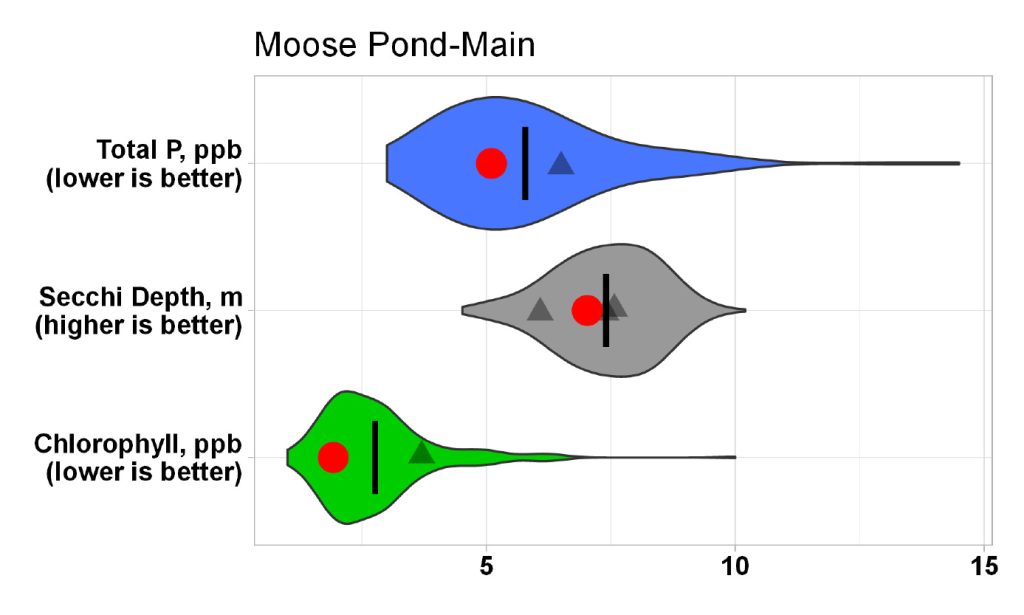
In terms of water quality, LEA measures three key variables – phosphorus, clarity and chlorophyl. Measuring the level of phosphorous in the lake is important because high levels of phosphorous can promote algae blooms. And so, when measuring phosphorus, lower is better. For clarity, higher is better and LEA measures water clarity using something called a Secchi Disk. For chlorophyl, lower measurements are generally also better as high levels of chlorophyl can suggest that a lake is becoming over-fertilized with nutrients that can trigger algae blooms and have other negative consequences for the lake longer term.
For the most recent monitoring period, LEA found the following.
- For 2024, average phosphorus, water clarity (Secchi depth), and chlorophyll were lower than or very close to long-term average conditions.
- Long-term trends through 2024 were stable (no change) except for a slight decrease in clarity and increase in phosphorus in the south basin (something to watch) and decreasing chlorophyll in the main basin (which is good news).
- Available data for 2025 (through early June) was typical of early season conditions.
One of the most important things that lakefront homeowners can do is to manage their properties in a lake-friendly manner by encouraging natural buffers between your house and the lake that filter out unhelpful sediment before it reaches the pond.